Sam Reviews Whatever He Feels Like

Just because.

Doing the Kefahuchi Shuffle
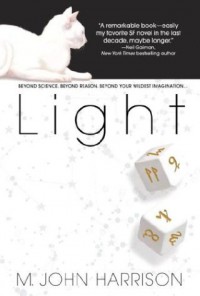
Light - M. John Harrison

If given the choice between Science fiction and fantasy, 9 times out of 10 I'll go for Fantasy. It's hard to explain why; perhaps it's something to do with the aesthetic, but I suppose that's a discussion for another time.


However, sometimes I'll look up from decapitating another loathsome Orc, see the sci-fi guys flying spaceships and blasting aliens overhead, and I'll think to myself, 'Well now, that does look fun'. 


I picked up Light by M John Harrison because I liked the book cover. Yes, I'm aware of the idiom warning against such rash action, but it worked for me when I bought 'The Wind Itself', so I figured why not try again.


Light is a culture shock. Truly. In my last post I reviewed Way of Kings, and I described how the book threw a lot of overwhelming concepts and ideas at the reader off the bat, but then drip-fed answers artfully when it made perfect sense to the plot.


This is what Light does. But more so. Much more so. After finishing the book, I feel like I'm still completely baffled by some of the things the inhabitants take as the norm. Surgically altered humans, virtual reality addicts, advanced physics and ghostly sentient mathematical algorithms are used liberally without much in the way of explanation.


For me, this everyday weird bafflement took away somewhat from the overarching mystery of the plot a little. When everything is unknown, it's sometimes difficult to pick out which unknowns are important, and which are just set dressing.


The rest of the culture shock simply comes from humanity's outlook and attitude 300 years in the future. It reminded me in some ways of the excellent Snow Crash, with it's bleak vision of future-cool and out-of-control morality. The only thing more prevalent than death is sex.


The main mystery of the plot revolves around the 'Kefahuchi Tract', a space-time anomaly described as "a singularity without an event horizon". Many civilizations have been drawn to the Tract over the history of the universe, and all have broken upon it's mystery.


Enter our main characters, a down and out adventure seeker, a ship pilot who has chosen to be absorbed into the consciousness of her ship, and a serial-killing physicist in the year 1999. Oh, and a woolen-coat wearing, horse-skull headed alien entity known as 'The Shrander'.


We follow them as they meander and weave their way through the deluge of unknowns, until the conclusion of the book when we get a straight up explanation of which unknown is the one that matters. I felt it was a little clumsy.


This clumsiness extends to a lot of the exposition in the novel. I feel like the author has realized at certain points during the narrative that the reader has no idea what's happening, and simply can't go on any longer without knowing what's going on. He then almost grudgingly writes a couple of paragraphs explaining whats up. When he feels like it.


Light was never boring, I'll give it that. If you enjoy reading about science-jargon, casual sex and ancient alien mystery, it definitely provides, and I'd like to re-review this book after reading the entire Trilogy. Whenever that happens.

Life before Death. Strength before Weakness. Journey before Destination.

The Way of Kings - Brandon Sanderson

I'd been planning on leaving off on reading Way of Kings. I'm part way through so many unfinished fantasy series at the moment I was hesitant to take on another, especially on that's only two out of eight parts completed.


The reason for this is that I'm impatient. I simply NEED to know what happens next. It turns out that I was right to be hesitant, because book one of the Stormlight Archive, The Way of Kings, is fantastic; waiting for the rest of the series is going to be torturous.


I think Brandon Sanderson is arguably the finest world-builder in the genre at the moment. In many books I've read, one character acts as a reader-proxy who knows little about the world, giving the other characters an excuse to explain to that character what's going on. The Way of Kings eschews this and throws the reader into the deep end. 


Strange place names, magic concepts and unusual natural phenomenon are all thrown around early on without much explanation, but having read a fair bit of Sanderson in the past, I was able to trust that it would all pay off eventually.


We learn about the world of Roshar and it's people extremely artfully, with exposition and small revelations paced correctly and complimenting the narrative perfectly.


The plot follows an artistic young woman with a dangerous mission, a slave with a tortured past and the brother of an assassinated king. While the characters possibly aren't quite as well-realised and instantly engaging as those written by Joe Abercrombie or Patrick Rothfuss, the way they are all involved and connected to the narrative more than makes up for it. 


The plot of every character is interesting, the mysteries are intriguing, an the setting is unusual and exciting.


The Way of Kings is a perfect example of modern fantasy writing, and probably the finest first-entry into a fantasy series I've ever read. Once I got started I really couldn't put it down, and if you can handle what will probably be many years of waiting for the next Stormlight Archive novel, then I recommend this book without hesitation.


Stoner

Stoner - John Edward Williams

I was sure for some time that I hated this book. It's a tale about the truly unremarkable life of a man named William Stoner. I found it incredibly depressing; the decisions of the protagonist were vague and weak. His passions were tinged with failure, frustration and missed opportunity. Instead of fighting the world, William Stoner often simply succumbs to it.


However, without being truly aware of when the transition happened, the book won me over. Whilst it's sad, it's also a poignant. William Stoner is a hero, in a strange way. Not a bold or a charismatic one, but one who is quietly enduring and humbly passionate. Ultimately, it is the story of a life defined by the desire to do what one loves.


I'm struggling to write a descriptive review of this book because reading it felt like something of a personal journey. Therefore, I'm not going to go into my thoughts on his marriage or his career, though anyone reading this should feel free to engage me in a discussion.


My initial frustration at the decision-making and bleak acceptance of the main character laid the path for a sort of quiet respect for a man who does his very best without excelling. William Stoner's life is one of quiet intensity.


Never before has a book exemplified to me so well the George R.R. Martin quote, "A reader lives a thousand lives before he dies. The man who never reads lives only one."


This book is one of those lives. Though the pacing of the book is excellent, I rarely found it comfortable to read. Troubling, insightful and thought provoking, I often found it difficult to shake off what I'd read after I put the book down. Contained within the pages are real human truths, and reading them has been a meaningful experience I won't soon forget.

S - Part 'o tha tradition

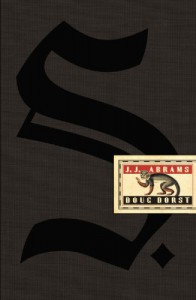
S. - Doug Dorst, J.J. Abrams

"What begins at the water shall end there. And what ends there shall once more begin."


S by Doug Dorst and J.J. Abrams is a fantastic acheivement. More than simply a novel, S strives to be an experience. I'll begin by talking about the package.


The book comes in a black sleeve with the title and author printed on it. You must break a seal in order to get inside, an ireversable act that adds to the feeling that you've got something special in your hands. Slide the book out of the sleeve, and you'll be holding a hardback book entitled 'The Ship of Thesus', by V.M. Straka.


Next I'll explain the premise of the book. V.M. Straka is a fictional author, and 'The Ship of Thesus' was the final novel he wrote before he was murdered. Straka was a figure shrouded in mystery, he never appeared in public and nobody knew who he really was.


'The Ship of Thesus' is the core of the story of  S, and it's fantastic. The main character, known only as S., wakes up with amnesia, and the story follows his journey. It's told almost entirely in the present tense, and the world that S. inhabits is hyper-real and abstracted, where time flows like ink from a pen. 


It's a story of power, love and humanity. It asks us how and why do we make decisions, and if ultimately it's possibly for our choices to really make a difference at all. For me, it would be a thought provoking and profound read, and that's without all the... distractions.


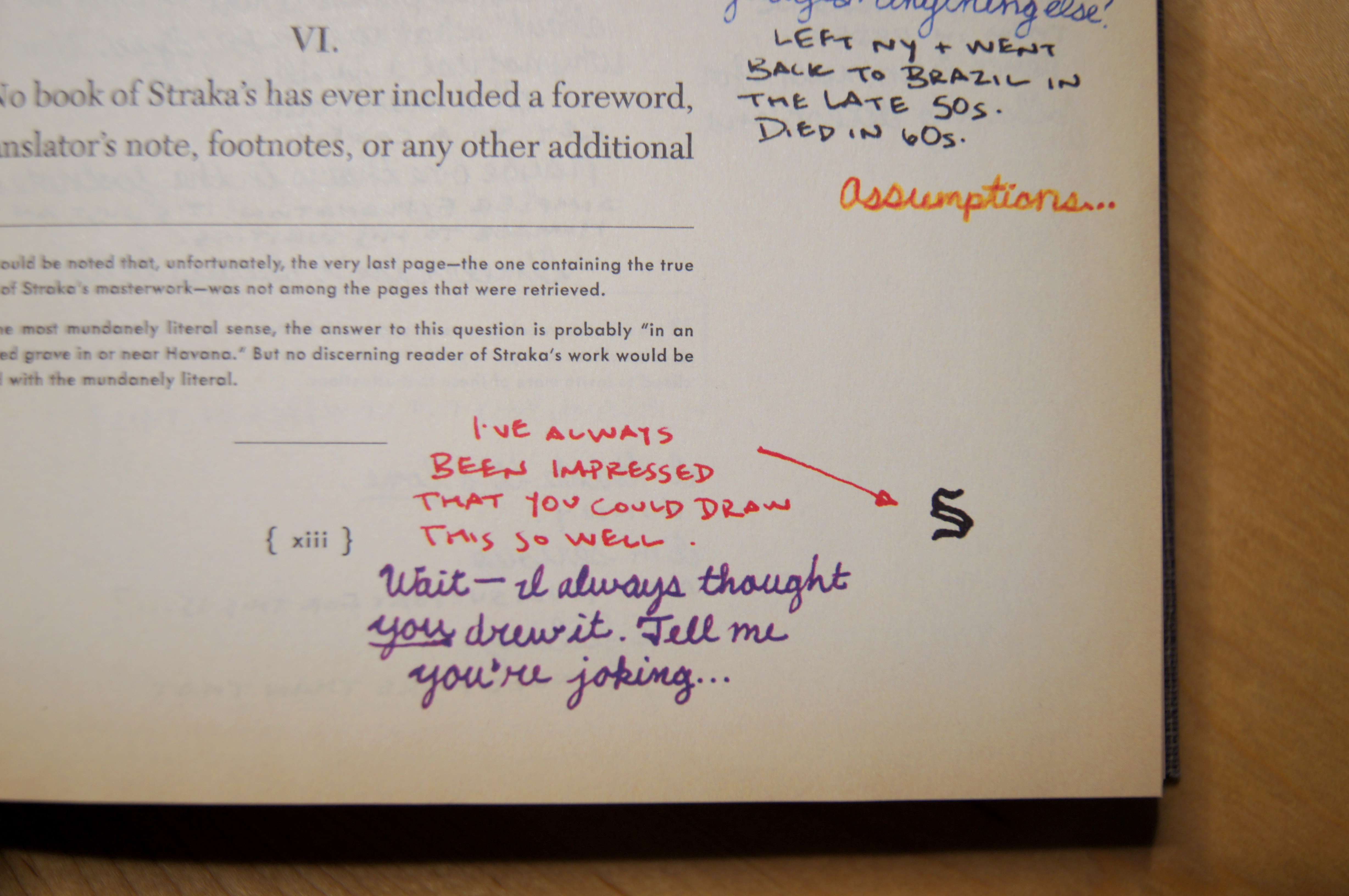
Handwritten in the margins of 'The Ship of Theseus' are the thoughts and communications of Eric and Jen. These two are an academic and a student who meet through the book, and together they delve into the mystery surrounding the author.


Theirs is a tale of self-discovery and secret organisations, and the book is strewn with postcards, maps drawn on napkins and other delightful bits and pieces. These props all feel very authentic, and the production value of the product as a whole is outstanding. It all adds up to a package that feels luxurious and engaging. Any bibliophile who simply loves delightfully crafted 'things' will get a thrill out of this alone.


This isn't to say that I didn't have a few qualms about the book. For me, the story told in the margins was not quite as engaging as the story told in the main text of the book. Reading also requires the eye to constantly scan around the page, following lines and unfolding bits of paper. This is fun, but constantly breaks the flow of the narrative, and it also takes a long time to process the information, making the book difficult to pick up for a short amount of time. It's a book that demands to have serious time and concentration dedicated to it.


The third element to the book is the social media element surrounding it. The book is choc full of coded messages, hidden elements and subtext. This is probably the aspect I've gotten into the least at this point, but I'm aware that die-hard fans of the book have spent many hours trying to unlock it's mysteries. For now, I'm content to let the forum users work this one out for me.


However, without spoiling anything, I'd highly recommend that anyone who has finished the book though follow this link. It contains an alternate Chapter 10, written as V.M. Straka originally intended, and it adds a lot to 'The Ship of Theseus'.


S is not a light read, but it's intriguing, rewarding, and a unique experience that I don't think I'll ever forget.

The Answer is Steel

Half a King - Joe Abercrombie

It's a new Joe Abercrombie! Huzzah! Bloody action sequences? Check. Someone falling over a cliff into a water-filled ravine? Check. Witty dialogue and complex characterization...? Let's see.


I've read all of Abercrombie's previous books, and this one feels different.


Half a King is the first of Abercrombies books not to be set in his 'First Law' universe. Half a King is set in a brand new Viking-esque land called the Shattered Sea. It's a tale of revenge and coming of age that follows the adventure of a young prince with a crippled hand named Yarvi. Yarvi is suddenly and unexpectedly thrust into Kinghood by the death of his father and brother. He's a weakling-king in a world where men are expected to fight.


Half a King wastes no time plot-wise. Things move forward at an almost alarming rate, with barely a moment of down-time. The plot itself was enjoyable, the familiar themes of a coming of age story were spiced up nicely by some excellent mysteries, twists and betrayals, and the overarching plot was concluded well.


The main thing I felt was missing from this story was the fantastic characterization from previous Abercrombie books. The plot was so heavily action-based that I felt I was missing some the fantastic character dialogue and development I'm so used to.


In Half a King, Abercrombie also reuses a lot of themes and ideas from his previous works. The theme of weakness in a leader echoes the plot arc of Calder (The Heroes) very closely. Shadikshirram, the charismatic and amoral Captain of the South Wind, feels like a knock-off Nicomo Cosca (Best Served Cold).


The book is a lot less bleak than his previous works, which I believe was the authors intention. Anyone who has struggled with the gritty and brutal nature of Abercrombie's books in the past might find some respite here.


However, the bleak and unforgiving nature of the First Law series was part of why I enjoyed it so much! It taught me about life and made me feel stuff, whilst grinding my face into the mud at the same time.


Half a King is a great novel, solid and well written, but it's written to appeal to a different audience than the First Law novels. Perhaps the two are mutually exclusive, and someone out there will find this to be their favourite Abercombie novel. However, I am not one of these people, and whilst I enjoyed it, I enjoyed Half a King only half as much as any of Abercrombie's previous novels. 

Have you seen the Yellow Sign?

The King in Yellow - 'Robert William Chambers'

The King in Yellow is a collection of short (mostly) horror stories by Robert W. Chambers, published in 1895. I took up the book because I'm such a Lovecraft fan, and it was cited by the master of cosmic horror himself as one of his inspirations.


The book was... terrifying. I find my every waking hour now spent brooding over it's words, it's insidious message seeping into my thoughts, undoubtedly leaving a bitter taint on any joy I might have ever felt for the rest of my days.


Except, that's not exactly how I felt upon finishing the collection. That's how it would have been if halfway through, the stories hadn't stopped being horror, and started being, well, tales of romantic Americans living in Paris.


What can I say? The first half of the book seemed to be building a terrifying shared narrative across the stories in which a playwright has written a terrible script that wracks the minds of men, turning them insane with it's terrible truths. The various characters across the stories are irrevocably changed after reading the King in Yellow, and events all seem to be connected to the mysterious threat of the King in Yellow and the Pallid Mask.


However, just as I was expecting these threads to come together, the stories just kind of... stopped being about the King in Yellow. I found myself reading each story following "The Prophets Paradise" and at first wondering where the theme had gone, then wondering why I was reading what I was, and eventually just being outright bored.


The stories that follow the horror section aren't terrible... they have value and stand alone well. In particular the battle imagery in "The Street of the First Shell" is beautifully and hauntingly described. They just don't seem analogous with the rest of the collection, almost like they'd just been added in to pad out the page count.


However, the first half of this book is still a fantastic read that any horror fan would enjoy; just don't be upset when the book fizzles out towards the end.

Saga Volume 1

Saga, Volume 1 - Brian K. Vaughan, Fiona Staples

"Most of my childhood was spent clinging to the feathers of a dulled arrow blindly fired across a starless night. It was heaven."


I don't read a lot of graphic novels, as a general rule. But Patrick Rothfuss said I should read it on his Facebook feed, and he was right about 'Welcome to Nightvale", so I obeyed.


Saga is a mature graphic novel that follows two deserters from a never ending galactic war as they try to raise a baby. 


The world of Saga is unique and somewhat surreal. The universe merges elements of fantasy into it's sci-fi, with characters casting spells and firing lasers all over the place. The creature designs for the various life-forms inhabiting the galaxy are incredibly varied and original, and it was a joy to see what the artist, Fiona Staples, would come up with next.


The plot is a love story at it's heart, and the characters are generally emotionally engaging and likeable. The story deals with some pretty heavy subject matter, child prostitution being one example, but it keeps it's focus and doesn't get too bogged down.


Saga is humorous, touching, engaging and beautiful, and I'd recommend it to anyone looking for a new graphic novel to get their teeth into. Personally, I can't wait to get my hands on volume 2.


PLEASE STOP READING OVER MY SHOULDER

The Shock of the Fall - Nathan Filer

Admittedly, this isn't the kind of book I'd usually go for. I tend to lean towards fantasy or high-concept escapism, rather than books dealing with real-world problems. However, I'm glad I gave this one a try.


The book is written from the perspective of a young man dealing with grief induced schizophrenia. I've never before read any account of mental illness which seems so believable and relatable. Mental illness is a tricky thing to portray from an outside perspective, let alone an internal one, and the Author's experience as a mental health nurse really shows here.


At the same time, the book is also very well written and poetic. The author frequently conjures such beautiful and poignant imagery that I wish I could copy entire chapters into this review as examples, but unfortunately you'll just have to take my inadequate word for it and find out for yourself.


The book also avoided leaving me worn out or depressed, as books about 'real life' often do. In fact, I came away from this book feeling uplifted, and that I'd gained some sort of new insight and understanding into mental illness. 


Overall 'The Shock of the Fall' was a great experience, and a great encouragement for me to leave my reading comfort zone every once in a while.

Are you feeling Loki, punk?

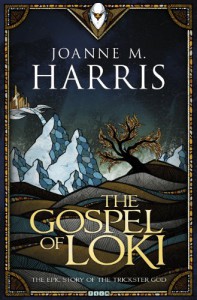
The Gospel of Loki - Joanne Harris

I'm a big fan of mythology. The ancient Greek, Egyptian and Norse polytheistic religions were abound with fantastic tales concerning the exploits of their pantheons.


With the excellent 'Vikings' TV series on Lovefilm, the fun Marvel 'Thor' films and my recent reading of Neil Gaiman's 'American Gods', my enthusiasm for all things Norse Mythological is currently at an all time high! There literally couldn't have been a better time for a book by a renowned author telling the story of one of my favourites, Loki the trickster God, to be released.


Which is why it's so disappointing how average this book was.


I felt that it got off to a good start, being wittily written and well paced. Unfortunately, the book never really moved on to the next level, and ended up being a rather flat retelling of Norse mythological stories.


The characterisation was surprisingly poor for a book about Gods, and whilst I suppose I was mildly amused and entertained throughout, I felt like the story completely failed to get me emotionally invested in any of the events of the book whatsoever.


The book left a bad taste in my mouth by ending terribly with a Ragnarok that utterly fails to tie up any of the plot threads in an interesting or meaningful way, and which ultimately left me feeling underwhelmed.


What have we learned today? Never trust the God of Lies, he'll just take your money and leave you with an average fiction.

World War Z (Hey buddy, it's cool now. You can let go.)

World War Z: An Oral History of the Zombie War - Max Brooks

World War Z taught me something about myself. It taught me that yes, I love zombies. And that's OK.


The kind of Zombie story I'm used to goes a bit like this: "Hello! These are the main characters. Here they are doing things that will establish their personalities. Oh look! A newspaper in the background with a headline about cannibal drug addicts, or a strange disease. Ah, there are an awful lot military vehicles driving by! I wonder what could be going on? *wink*".


Then the something dramatic happens, involving our loveable undead antagonists. And then that's the last we hear of civilization as we follow our hapless group of survivors as they attempt to weather the scourge.


Now there's nothing wrong with this; this is where we get the intense human drama I love that springs up from an apocalypse scenario; what should we do with this man who's been bitten? How much should we trust these strangers? However, the reason I loved World War Z is because it does things differently. It gives us a truly global view of the Zombie apocalypse. What happened to those military vehicles? How did the disease spread? In what ways did the different governments of the world handle the situation?


Told in the format of a series of interviews, World War Z cobbles together the story of humanity as a species during World War Z. Alternately political, thrilling and deeply psychological, Brooks leaves no stone unturned when painting his picture of the war. The story is brilliantly put together, well imagined and well fleshed out. The various interviewees are also cleverly chosen, ranging from soldiers to refugees, from a Japanese Otaku to an astronaut watching events unfold from the International Space Station.


The sections of the book that I ended up enjoying the most were those touching on the human psychology of an apocalypse scenario. I found the idea of Quislings in a zombie situation particularly interesting. How does one attempt to collaborate with an enemy that shows no desire other than to eradicate life, and what would drive a person to do this? How do you stay sane when the world suddenly ceases to make sense?


Needless to say, World War Z was a great read, and whilst there are a couple of slow chapters, I would recommend this to anyone at all with an interest in Zombies or the Apocalypse. In fact, I'd recommend this to anyone with brains. Mmm. Brains... 

Imagine a boot stamping on a human face, forever.

Nineteen Eighty-Four - George Orwell

"It's a classic! It was way ahead of it's time!" Clamoured the masses. I couldn't ignore them any longer (and a friend bought it for me), so I read it. It was great.


The thing that surprised me the most about 1984 was how human the story was. I'd already read Orwell’s Animal Farm, and enjoyed it, but it felt to me like an elaborate metaphor. It was, and it was clever, but I felt a certain emotional disconnect reading it.


The moment that really hooked me was the moment Winston read the message

"I love you"

(show spoiler)

 on Julia's note. I, like Winston, was expecting something from the thought police, or an underground resistance, but I was surprised, and it was brilliantly done.


Winston is a fantastic lead character, fitting into his world perfectly. His thoughts are brutally honest, and sometimes shocking, but we forgive him for it, because we understand him.


The book delves deeply into the idea of what a world might be like where the pursuit of power over others has been led to it’s ultimate conclusion; a world where power is sought and maintained merely for it’s own sake.


The book gave me lots to mull over afterwards, which is a good sign. Happy or contented people are unlikely to seek power, and those who seek power will often end up as the ones who obtain it, regardless of their moral standpoint. The psychological questions raised by this book concerning morals, perceived sanity, and the very nature of organised society are fascinating, and ones that will resound deeply with anyone even slightly politically minded.


Is 1984 the future? Often the book echoes our own society in uncomfortable ways, a testament the the forward-thinking of the Author. Who knows, perhaps the Ministry of Records will change the title to have always been 2084, and with a little doublethink, we’ll believe it too.

The Girl all the Guildsmen Fear

Kinslayer  - Jay Kristoff

I just checked out the American book cover; the art just nails the tone of these books. Yukiko, goggles around her neck looking bad-ass whilst a Dragon and an Arashitora battle behind her? Fuck yea! I just don't dig the more subtle English covers of Yukiko doing yoga by waterfalls. I'm posting a picture of the American art at the bottom of the page for your enjoyment.


Anyway, onto the review. Jay Kristoff continues the Lotus War with another action packed, chi-fuelled Japanese Steampunk adventure. Whilst less emotional than Stormdancer, Kinslayer continues Yukiko's tale in style.


Kristoff introduces a slew of new characters, notable for the fact that most of these are take-no-shit, kick-ass women. Whilst I found it incredibly refreshing to read a book led by strong female characters, I did on occasion worry that No-one, Michi and Yukiko all sometimes felt like the same character in different situations. Unless Jay Kristoff was doing this on purpose. Actually, the more I think about it, the more I think he probably was. Good show.


In any case, this isn't an overly negative point from me, as I greatly enjoyed the different stories of these characters, particularly Michi's tale of love and duty. I look forward to seeing how these characters develop in next book.


Jay Kristoff seems a little more comfortable with his writing style this time around. He uses a lot of beautifully descriptive metaphors, often describing the same thing differently when viewed from the perspective of different characters. It's a joy to learn about the characters from their descriptive perceptions. This book is also a lot more brutal and gory than I remember Stormdancer being, but it's all well written, with the final few chapters being completely gripping.


To be honest, I flew through this book in almost no time at all, and enjoyed it all the way. If there's better praise for a book out there, then I've yet to hear it.


Kinslayer American Cover

American Gods

American Gods - Neil Gaiman

The first Neil Gaiman book I read was Neverwhere, and to be honest, it didn't grip me. However, I was convinced to give him another go, and I'm glad I did, because American Gods is a masterpiece.


Neil Gaiman presents a world where Gods are created from the thoughts and worship of their followers. These Gods were bought to America in the minds of immigrants, but as time moves forward, and people lose their cultural connections with their homeland, the power of the old Gods such as Horus & Odin wane, whilst new Gods of Television & Media wax strong.


The lead character, Shadow, is caught up in the coming conflict between old and new, and the plot follows his perspective as he encounters the holy places and beings of America.


The framework of American Gods is the theme of Immigration, and how ideas evolve or are forgotten when transferred across time & distance. Woven into this story is a tale of love, mystery, crime & deception, and it all works together in a way that feels powerfully human.


I listened to this book in it's audio form, and I'd like to make a special mention to the quality of the narration. The bulk of the book is narrated by George Guidall, with several fantastic chapters on immigration being narrated by Neil Gaiman, and all of the characters are given their own voice actors.


This book touched on many themes I love, such as the depth of history, cultural evolution, mythology & folklore, and the whole thing was not only beautifully told, but often deeply profound.

We are Pack

The Complete Farseer Trilogy: Assassin's Apprentice, Royal Assassin, Assassin's Quest - Robin Hobb

Well I've made it through the Farseer Trilogy. I feel worn out.


I was recommended this book by a few friends who'd read it when they were younger. I think I would have appreciated these books a little more if I had too, and the reason is this: TEEN ANGST.


So much angst! And self-pity! My main critisicsm of the Farseer Trilogy for me was the leading character, FitzChivalry Farseer. Told in first person from Fitz's perspective, the Farseer Trilogy covers his life from a young boy to a man. We spend all our time with him, and to be honest, he's a tough character to be around.


Robin Hobb tells the story of a boy who essentially has no choices; Fitz spends the entire trilogy being swept from event to event against his will and moaning about it all along the way. After a while, I wearied of the endless griping and just wanted to give him a slap and tell him to get on with the story.


The supporting characters are a mixed bunch too. While most characters are interesting and well developed, such as the Fool, Nighteyes and Burrich, other characters like Molly & Regal seemed a little underdeveloped in relation to how much I felt I was supposed to care about them. 


That said, I didn't hate the Farseer Trilogy. Far from it. The story was well told, and always kept me guessing. Never once did it take me where I expected it to, and it was this that kept me going to the end, where all the threads came together in a satisfying conclusion.


The world that Hobb builds is an interesting one, full of subtle magic, mystery, intrigue and turmoil. I'm just not sure I'm much interested in the people who live there.


The Sam Guide to Star Ratings

1 Star: Read at your own peril.


2 Stars: Nope, unless it's part of an epic series and you NEED to know what happens.


3 Stars: Entertaining, but forgettable. Like a Marvel film.


4 Stars: This is a Great Book. You should definitely read it.


5 Stars: YOU HAVE MY UNDYING FANDOM, YOU FIVE STAR MASTERWORK!


SPOILER ALERT!

Brandon Sanderson's Legion *very minor spoilers*

Legion - Brandon Sanderson

Brandon Sanderson is an author who seems always to be waiting somewhere down my to-read list.


This isn't because I put off his books; it's more because he's such an incredibly prolific writer, I could probably spend the next year or so devoted solely to going through his back-catalogue. Whilst this would undoubtedly be a year well spent, I feel the need to spread the love.


That's why it was a pleasure to be able to sneak the novella Legion into a couple of tube journeys on my way to work.


This is the first modern day Sanderson book I've read, and it proves to me that he isn't just a great fantasy author, but a great author in general. 


Legion follows the story of Leeds, a man with a mental illness that manifests itself in the form of hallucinations that only he can see. These hallucinations Leeds calls his 'aspects', and each is a person with specialist skills that Leeds can call upon to help him out. These specialists essentially give Leeds his own mental investigation team.


Sanderson raises some interesting thoughts on the classification of madness, in particular how the perceptions of society shape the difference between classifying someone as 'insane', 'eccentric', 'sane', etc. If Leeds is able to look after himself and is safe to be around, why shouldn't he be considered sane, despite the hallucinations?


Putting issues of sanity aside, the plot of the novel is exciting and inventive, being a great little tale in it's own right, whilst leaving enough mystery and unanswered questions that I hope, nay, DEMAND that a sequel be written.


In your own time though Brandon, please, I need some time to catch up.